You’re doing the work – searching, learning, advocating – because the system doesn’t just hand you answers. Get the answers you need now.
Experiential Life
One Place | Less Overwhelm | More Clarity

From Fights to Rights: Finding Your Voice at the IEP Table
You’re told you have to fight…
Fight for everything or you will get nothing.
We gathered our arsenal.
We had a special education teacher and a special education liaison from our district helping us prepare for the next IEP meeting.
We were praised for having the forethought to NOT sign the IEP before fully understanding the implications.
The team was recommending C be placed in a self-contained special education classroom for Kindergarten – and it seems – for the remainder of his school career.
And while a self-contained classroom is sometimes the right choice, we felt very strongly that this placement was premature.
We decided the best way to know for sure was to tour the classroom – it took all of 5 minutes for my husband and I to give each other the telepathic message that “nope” this is not the right placement for our son.
When Your Gut Screams "Nope"
When we walked into the classroom, the lights were off.
There was a group of maybe 10 children, some in wheelchairs, some on the floor, some in beanbags, others in chairs – all facing a projector screen with the circle time activity displayed on it.
There was a teacher and 2 aides dispersed between the children.
I looked up, and there was a child scaling the windowsill, as an aide held his hand, trying to coax him down.
There was a bathroom inside the classroom – and the classroom was about as far away from the main entrance as possible.
But don’t worry, the kids in this classroom dismiss earlier than the other kids to board their bus without the hustle and bustle of regular dismissal.
Lunch and snacks – served inside the classroom.
When do these kids get to be with the other kids – during assemblies mostly – but that depends on how the class is doing on that particular day.
It was segregation disguised as support, and I hated it.
They Checked a Box That Decided His Future
I got home and started writing emails like my son’s life depended on it… and in some ways, it did.
Buried, in a tiny little box, in a sea of boxes and tables and words, were 2 check boxes:
◻︎ Diploma Track
◻︎ Certificate Track
☑︎ Certificate track was checked.
I would have never noticed it, had our special education teacher friend not pointed it out.
I would have never thought twice about it, had she not said, “it’s harder to go back to diploma track than it is to move to certificate track.”
But what did that mean??
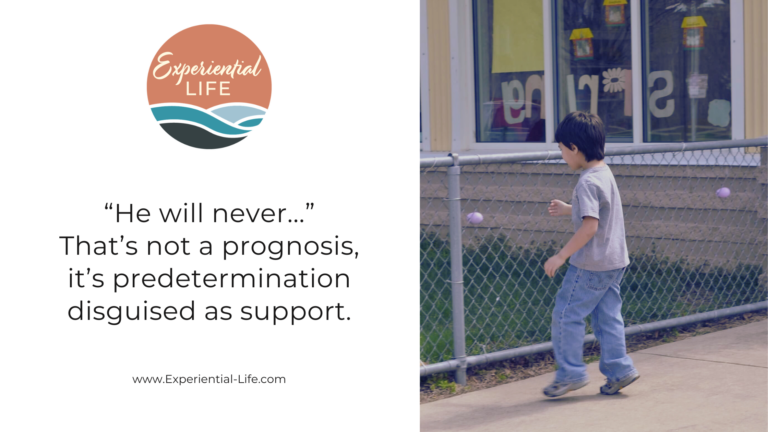
It meant that along with recommending C for the self-contained classroom, they were deciding – AT 5 YEARS OLD – that he would not be able to meet the requirements to graduate high school with a diploma.
And friends – that broke me.
I heard “he will never…”
And I thought, “watch him…”
I felt like they were forcing their “he will never…” narrative onto a child that was never given a chance to try.
My heart was shattering – but my anger at the absurdity fueled action.
From Begging for Inclusion to a Culture of Inclusion
C’s special education preschool program was not at our neighborhood school.
I volunteered in all my children’s classrooms weekly, so I got to know the principal of our neighborhood school, and I called her…
Crying…
And begged that she give my son a chance.
Looking back it’s ridiculous.
I had to beg for the school to give my son a chance to be included.
Actually – I didn’t…
Because the principal at our neighborhood school believed in inclusion – knew the meaning of Least Restrictive Environment – knew they couldn’t predetermine placement.
I will never forget the call with her. Sitting at my desk, snot running down into my mouth, tears mixing with mascara and making my eyes burn.
And her words – “Of course Mrs. Russell. Would it help if I attended the next IEP meeting?”
But first – I needed to come up with a strategy.
Because they weren’t wrong in saying that C wasn’t ready for a full day of general education Kindergarten…
He just shouldn’t be forced into a setting that would ultimately dictate his remaining 16 years of school.
Strategy, Support, and Services - Oh My
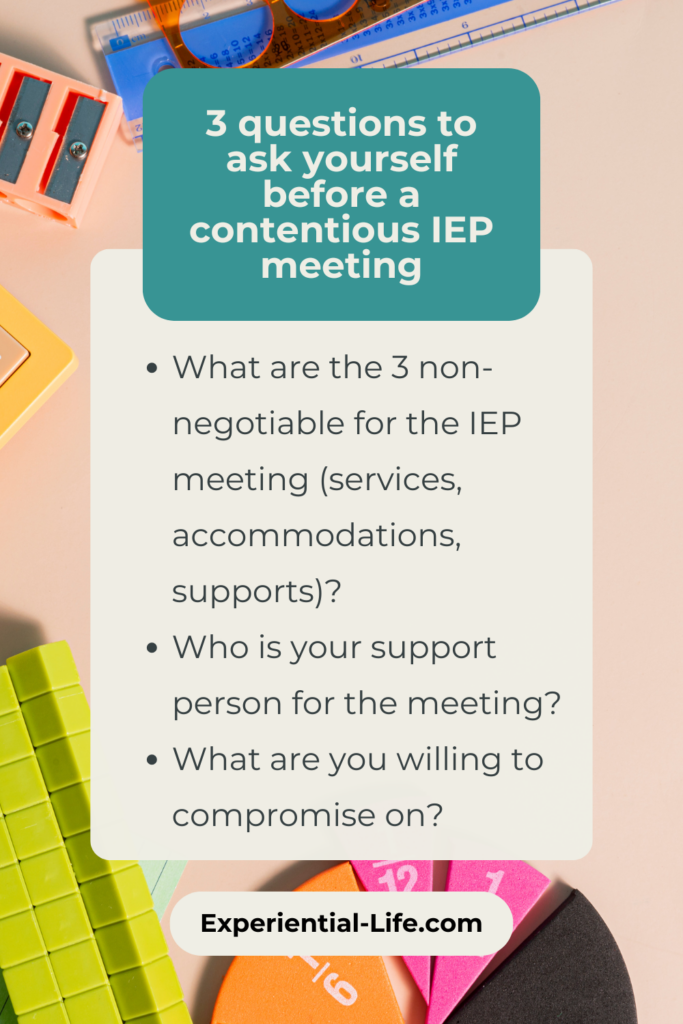
I called my own “pre-meeting” with my advocate, and we wrote down the 3 things that I felt were most important to accomplish during the next IEP meeting:
→ Allow C to remain in the Pre-K program at his neighborhood school
→ Provide C with a 1:1 aide that could help with toileting
→ Give C a chance to learn beside non-disabled peers
And then we scheduled the next IEP meeting.
My district has a special education liaison that works with families – I believe it is unique to Maryland – but it’s called Partners For Success.
They provide the tools and information necessary to empower parents to support their child’s educational program.
And there are mixed reviews on the support this program provides, but it was literally what made our next IEP meeting successful for C.
Because we walked into the meeting with my 3 non-negotiables.
We had the support and participation of the principal from our neighborhood school.
We just needed to hash out the details – what would C’s school day look like, and what services, supports, and accommodations would the school provide?
And y’all, because C turned 5, technically he was eligible for a full day of school.
But – the Pre-K program was only ½ day.
We were prepared to just let it be – not push for a full day, because moving him to our neighborhood school, allowing him to be in a classroom of non-disabled peers felt more important.
But our liaison said, “what if C could do the ½ day pre-K program, and have his aide move with him to the Kindergarten class in the afternoon for lunch, recess, and specials?”
And you know that sound of records scratching as if abruptly stopped – yeah, that sound played in everyone’s head.
The principal at the school where C attended his special education preschool class said, “that’s never been done before – I don’t know that you could do that.”
And the principal of our neighborhood school said, “well – let’s talk it through real quick…”
And y’all…
By the end of the meeting, we had officially moved C from the special education program to a general education program.
With a 1:1 dedicated aide, who followed him for the duration of his entire day.
With a hybrid ½ day pre-k and ½ kindergarten program designed just for him.
No need for him to be toilet trained, thank you very much.
No need for him to choose between being with his non-disabled peers or not.
And the backing of a principal who believed in giving him a chance.
When Services Change, Telling Your Caregiving Story Matters
Had I not shared our story with the principal from our neighborhood school, we would have either:
– accepted defeat and the self-contained placement
– fought – a timely and costly fight for our child to be in an inclusive classroom
Our story has power.
Our advocacy has power.
But only if you know how to leverage the power.
Some may call our experience luck…
Which is why we are bringing in long-time disability and healthcare advocate and mom to an autistic adult with epilepsy, Pattie Archuleta.
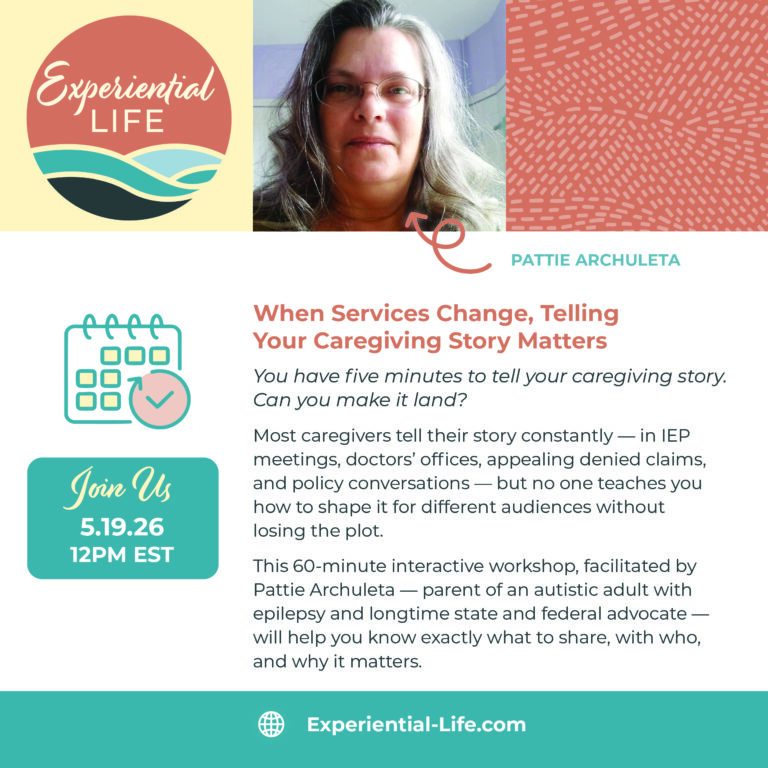
She’s managed federal grants that support children and youth with special healthcare needs.
She knows how to turn what people think is luck into a repeatable advocacy skill.
Because you never know when you will need to leverage the power of your story to make sure your child gets a seat at the table, with the services, supports, and accommodations they need.
Join us
🗓 Date: May 19, 2026
⏰ Time: 12pm EST
⏱ Length: 60 minutes (interactive)
📍 Live on Zoom
AND, if any of this resonates, please share this article with your network and subscribe to the newsletter to get instant access to future articles, weekly advocacy tips, exclusive event invites, and news you can use.