You’re doing the work – searching, learning, advocating – because the system doesn’t just hand you answers. Get the answers you need now.
Experiential Life
One Place | Less Overwhelm | More Support

When “Support” Feels Like Punishment: 3 Questions To Ask Before Emailing the IEP Team
“Am I overreacting – I just need someone to tell me what to do.”
Last week, a parent asked:
“What would you do if your child was told they can no longer eat lunch in the cafeteria — they have to eat in a classroom with their aide?”
And honestly?
I was speechless at first.
When Punishment Is Disguised As Support
I remember the cafeteria – loud, and sometimes smelly. The clanking of trays, the laughing, the sound of sneakers squeaking on the floor, the mixture of overcooked canned green beans mixed with slightly burnt french fries …
It’s kind of a sensory nightmare – and it’s also a necessary break from the rigidness of the classroom.
So I asked, “How long does your child have to eat lunch in the classroom? And what happened?”
Her child loves being social and like many of our kids, struggles to make friends.
On this particular day, they were eating at the table, and they kept trying to join the conversation – and kept getting ignored, kept seeing eyes roll, kept hearing whispers and laughter around him…
And it was too much. They jumped up to run to the bathroom, and in the process hit the table and sent trays and lunch boxes flying.
That’s it. That’s the moment when the teacher and principal decided they should have a “quiet place to eat.”
But is that what this child actually needs – more importantly, is it what they want?
Behavior is communication.
And lunch is part of the school day.
Which means the IEP applies there too.
There should be services, supports, and accommodations in place to help them navigate transitions, social interactions, and sensory overload – including lunch and recess.
So when the email came in and said, “we want to support your child so they have a safe and calm lunch experience…”
It sounded a lot more like removing their child… in order to keep the peace.
It’s Easy to Go Into Mama Bear Mode
When she asked me, “Am I overreacting?” I heard the words she didn’t say:
“This feels wrong. I am pissed, I am sad, and I have no idea what to say or do.”
Because that’s the part we don’t talk about.
The moment after something happens – after the email, after the phone call, after the food flies…
When your chest is tight and your brain is already drafting the email.
You open a blank message to the IEP team, stare at the cursor blinking – it feels like it’s taunting you…
You are thinking about what you want to say vs. what you should say. What they’re going to think when you do drop off tomorrow – what they’re saying behind your back, before the next meeting…
It feels like you’re spiraling.
You feel protective.
You feel angry.
You feel like your child is being punished for their diagnosis.
Those feelings are legit – valid – true for you.
AND there are moments when the most powerful move isn’t louder - it’s clearer.
AND there are moments when the most powerful move isn’t louder – it’s clearer.
Sometimes you have to think two steps ahead.
To respond strategically – not just react emotionally.
I wanted to slow her down.
Not because she was wrong.
Not because the cafeteria decision didn’t deserve scrutiny.
But because before she emailed the IEP team, I wanted her to know:
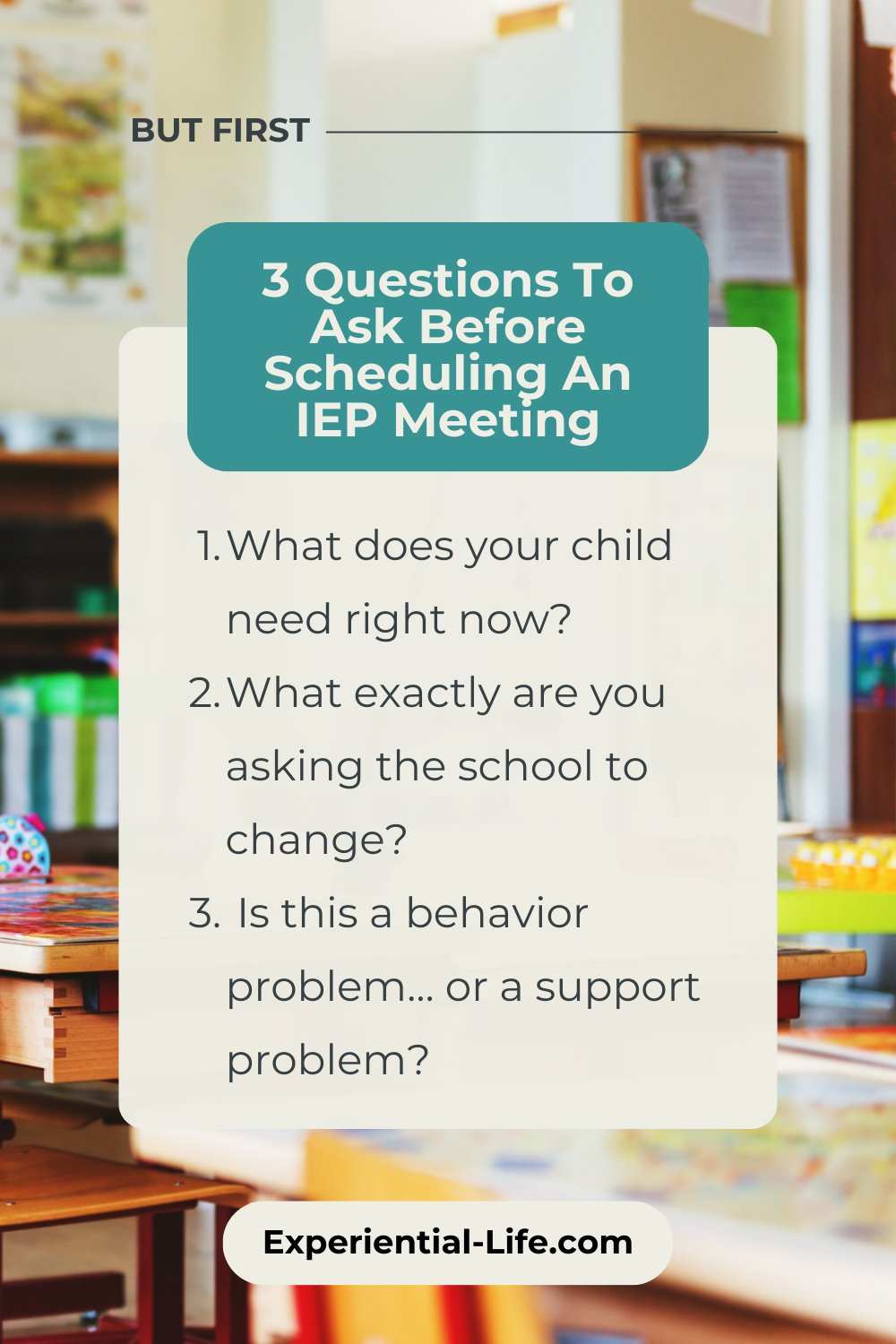
→ What does your child actually need right now?
→ What exactly are you asking the school to change?
→ Is this a behavior problem… or a support problem?
Because those are not the same thing.
And the answer changes everything about what you say next.
The Question Most Families Skip
Before you fire off the email to the principal, you have to ask:
What does the IEP already say about transitions? About social support? About regulation?
Because removing a child from lunch doesn’t teach regulation – and it feels a lot like punishment.
And when a child is separated from peers as a response to behavior, that’s often a signal that the IEP needs to be revisited – not that the child needs more consequences.
This Is What Your IEP Team Should Be Doing
The IEP is a living document – you don’t set it and forget it.
It’s supposed to be updated as progress is made, or not.
And sometimes – it needs to be revised – right in the middle of the year.
If you are unsure, ask yourself:
❓ Are the goals aligned with my child’s needs right now?
❓ Are the supports in place for my child or for compliance?
❓ Is the plan individualized, based on my unique child and their educational needs?
When families understand how to evaluate what’s written, how it’s being implemented, and how to request changes mid-year – it stops feeling like a fight and it starts feeling the the next right move.
They know what to ask.
They know what to look for.
They know what to say.
And they stop second-guessing themselves.
If you’ve ever asked,
“Am I overreacting?”
What you’re probably feeling is that something doesn’t line up – and you don’t know how to say it without making it worse.
You don’t need to become an educational advocate overnight.
You don’t need to threaten due process.
And you don’t need to sit quietly and hope it resolves itself.
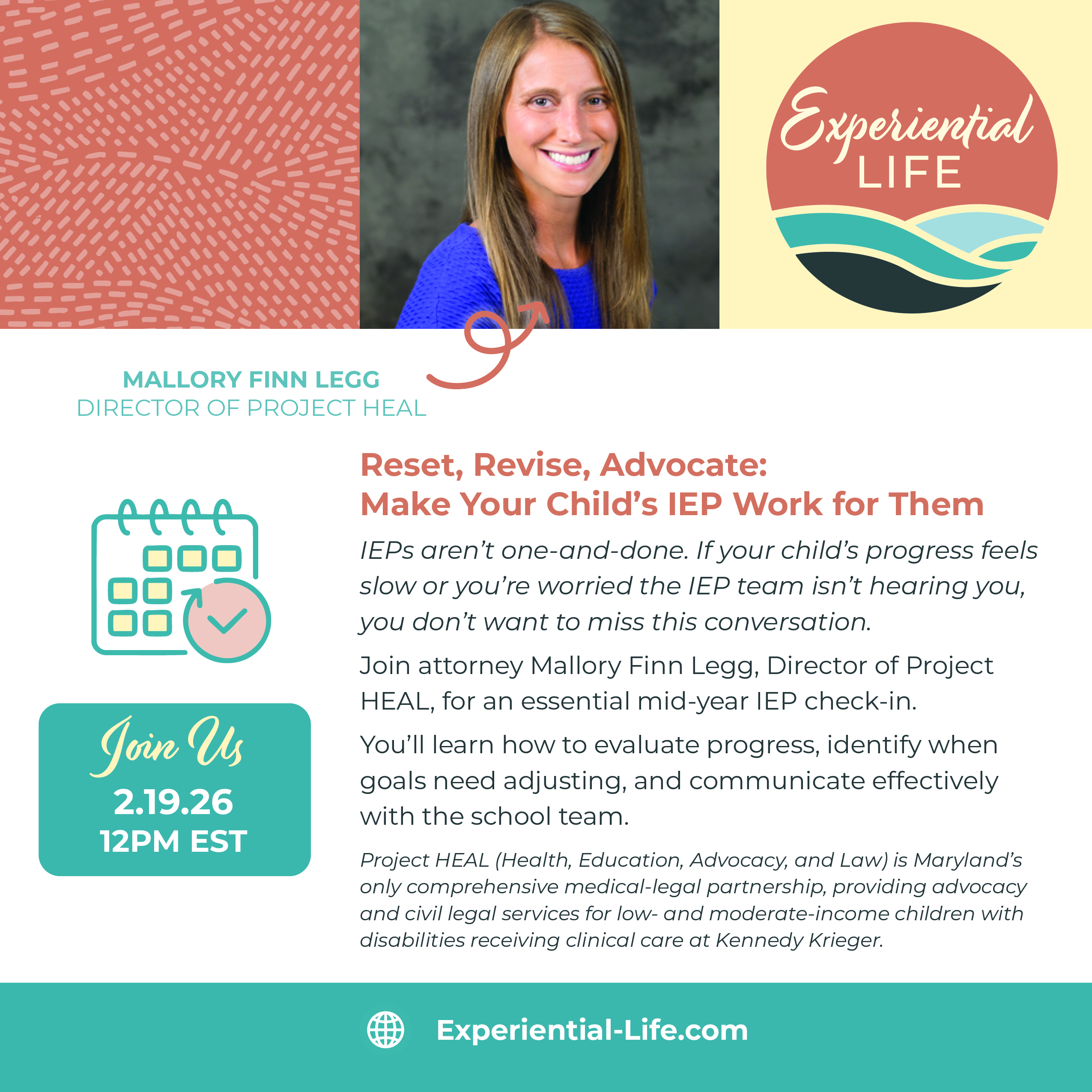
That’s exactly why we’re hosting the Mid-Year IEP Check-In.
We’re walking through:
✔️ How to request an IEP meeting mid-year
✔️ What to say when something feels off
✔️ How to evaluate whether supports are working
✔️ And communicate with the team – without being labeled “that parent.”
Because you don’t have to choose between staying silent and going nuclear.
There’s another option.
And once you see it, you won’t unsee it.
If you’re staring at an email draft right now…
Or you know you will be soon – this conversation was built for you.
Join us on February 19, 2026 at 12pm EST.
If you’re not able to attend live, the replay lives inside the Experiential Life app.
You can learn more here: https://experiential-life.com/experiential-life-app/
AND, if any of this resonates, please share this with your network and subscribe to the newsletter to get instant access to future articles, weekly advocacy tips, exclusive event invites, and news you can use.