Month: February 2026

  • The Hidden Problem With Disability Resources

    The Hidden Problem With Disability Resources

    ($30,000 and a stack of referrals later)

    C is a white teenaged boy standing outside in the middle of a snow storm. He is wearing a winter hat and an orange and beige snow coat. There are trees covered in snow behind him.

    Yesterday, our little island was issued a blizzard warning… and it reminded me of the day the pediatrician said, “Christy, I think your son is autistic.”

    All those years ago, when the pediatrician dropped what felt like a bomb in my lap – we were ordered to evacuate because a hurricane was barreling toward us…  and it felt like some sort of sign from the universe.

    My brain screamed, “RUN” from all the chaos…

    And in answer to the chaos surrounding me, I got a stack of referrals and a few pamphlets… in the midst of “ways to prepare for the incoming storm.”

    Okay universe… I am paying attention.

    Why Families Feel Like They Are Failing

    That year, we spent $30,000 out of pocket seeing every specialist and therapist we got referred to. 

    I was juggling work, multiple appointments a week, two different schools, insurance calls, and two older kids with full lives of their own. 

    My husband was working nights. We were always in the car. Always coordinating. Always reacting.

    And I broke.

    Not because of my autistic son…

    But because I felt like I was alone, in the middle of the storm, with information being thrown at me – decisions to be made – and yet no real and meaningful support behind me.

    No one explained how the systems worked.

    No one translated the language.

    No one said, “This is hard to navigate… let me help.

    You Can’t Navigate What You Don’t Understand

    So I started asking.

    I sent cold emails. Made cold calls. Showed up to meetings. I wanted to know:

    ❓ What am I supposed to do?

    ❓ What do these acronyms and words actually mean?

    ❓ Is there help for the medical debt?

    ❓ How is anyone supposed to work 40 hours while caregiving 24/7?

    The answers to most of my questions existed – but they didn’t live where I expected to find them…

    They live in the heads of the people who work in the systems – which is bonkers!
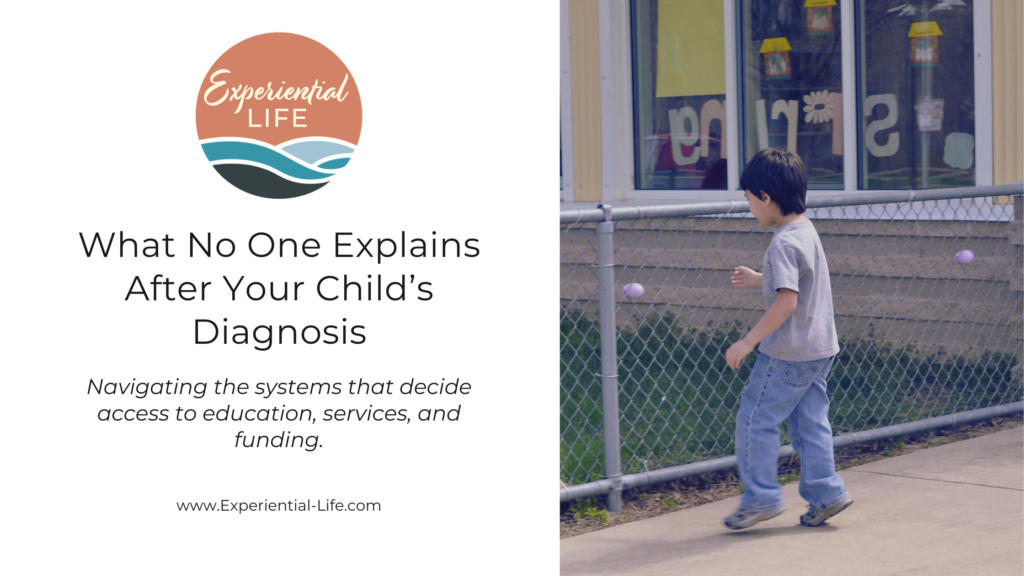
    What no on explains after your child's diagnosis: Navigating systems that decide access to education, services, and funding. Image of C standing at the fence of a playground at school. He has short brown hair and is wearing a gray t-shirt and jeans.

    Over the last decade, I’ve worked with more than 1,000 families and partnered with over 100 providers, professionals, agencies, and hospital systems.

    I’ve managed federal and state funding, and sat inside the systems families are expected to navigate alone.

    I learned how they work – from the inside.

    Not from pamphlets.

    Not from Facebook groups.

    From the rooms where decisions are made.

    And what I realized is this:

    Families aren’t failing.

    They’re navigating complex, siloed, and hard to understand systems.

    Access Shouldn’t Depend On Luck, Word Of Mouth, Or Who You Meet
    It’s been almost 15 years since my son’s diagnosis… and not much has changed.

    2 years ago, I started hosting presentations from local disability organizations for my son’s inclusive theater group.

    Afterward, parents kept coming up to me.

    Thanking me.

    Asking follow-up questions.

    Writing names and taking numbers like they’d just been handed a lifeline.

    Over and over, I heard the same sentence:

    How did I not know this existed?

    These weren’t new or exclusive organizations.

    Families just didn’t know they existed – because you don’t know what to search for if you don’t know something exists.

    That’s when it clicked.

    Access to information, resources, and support depended on word of mouth, luck, and who happened to be in the room.

    I couldn’t live with families’ access to support depending on who they know instead of what they need.

    One Place. Less Overwhelm. More Support

    This is what I wish someone had handed me instead of a stack of referrals.

    That’s why I built Experiential Life.

    Not another stack of referrals.

    Not another 40-tab research spiral.

    A place where families go to:

    → Meet the people that work inside the systems – so you don’t have to search for them

    → Understand why the school won’t give your child more speech services, when the developmental pediatrician said they need more.

    → Get the words to say on the phone when insurance denies your request for therapy that will help your child buckle their seatbelt.

    → Stay up to date with policy and funding changes that happen every year

    → Be in a community that shares your struggles and understands why socks with seams are enemy number 1 in the morning rush.

    We shouldn’t need to change careers to understand the systems.

    We shouldn’t need honorary legal, medical, and educational degrees.

    It should be easier to get support and services for our neurodivergent children.

    If you’re tired of feeling like you were handed a stack of referrals in the middle of a hurricane, and told, “Godspeed,” this space was built for you.

    AND, if any of this resonates, please share this article with your network and subscribe to the newsletter to get instant access to future articles, weekly advocacy tips, exclusive event invites, and news you can use.
    Do you crave trustworthy information and resources to help you support your Neurodivergent child?

    Subscribe to the Experiential Life newsletter and get advocacy tips, exclusive event invites, and news you can use - delivered straight to your inbox.

      We won't send you spam. Unsubscribe at any time.
    • When “Support” Feels Like Punishment: 3 Questions To Ask Before Emailing the IEP Team

      When “Support” Feels Like Punishment: 3 Questions To Ask Before Emailing the IEP Team

      “Am I overreacting – I just need someone to tell me what to do.”

      Last week, a parent asked:

      “What would you do if your child was told they can no longer eat lunch in the cafeteria — they have to eat in a classroom with their aide?”

      And honestly?

      I was speechless at first.

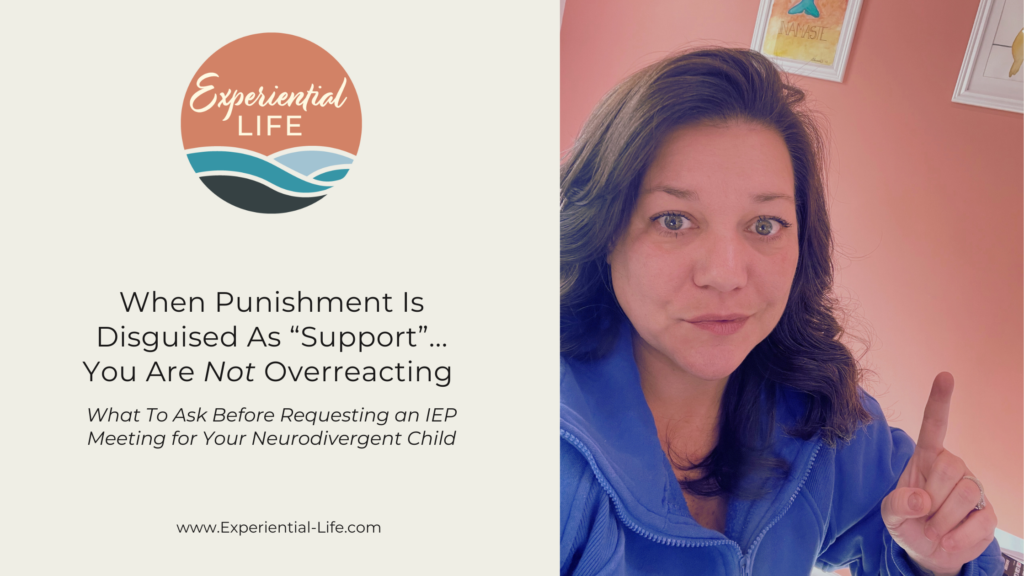
      Text on graphic reads: When Punishment is Disguised as Support - you are not overreacting. What to ask before requesting an IEP meeting for your neurodivergent child

      When Punishment Is Disguised As Support

      I remember the cafeteria – loud, and sometimes smelly. The clanking of trays, the laughing, the sound of sneakers squeaking on the floor, the mixture of overcooked canned green beans mixed with slightly burnt french fries …

      It’s kind of a sensory nightmare – and it’s also a necessary break from the rigidness of the classroom. 

      So I asked, “How long does your child have to eat lunch in the classroom? And what happened?

      Her child loves being social and like many of our kids, struggles to make friends. 

      On this particular day, they were eating at the table, and they kept trying to join the conversation – and kept getting ignored, kept seeing eyes roll, kept hearing whispers and laughter around him…

      And it was too much. They jumped up to run to the bathroom, and in the process hit the table and sent trays and lunch boxes flying.

      That’s it. That’s the moment when the teacher and principal decided they should have a “quiet place to eat.”

      But is that what this child actually needs – more importantly, is it what they want?

      Behavior is communication.

      And lunch is part of the school day.

      Which means the IEP applies there too.

      There should be services, supports, and accommodations in place to help them navigate transitions, social interactions, and sensory overload – including lunch and recess.

      So when the email came in and said, “we want to support your child so they have a safe and calm lunch experience…”

      It sounded a lot more like removing their child… in order to keep the peace.

      It’s Easy to Go Into Mama Bear Mode

      When she asked me, “Am I overreacting?” I heard the words she didn’t say:

      “This feels wrong. I am pissed, I am sad, and I have no idea what to say or do.”

      Because that’s the part we don’t talk about.

      The moment after something happens – after the email, after the phone call, after the food flies…

      When your chest is tight and your brain is already drafting the email.

      You open a blank message to the IEP team, stare at the cursor blinking – it feels like it’s taunting you…

      You are thinking about what you want to say vs. what you should say. What they’re going to think when you do drop off tomorrow – what they’re saying behind your back, before the next meeting…

      It feels like you’re spiraling. 

      You feel protective.

      You feel angry.

      You feel like your child is being punished for their diagnosis.

      Those feelings are legit – valid – true for you.

      AND there are moments when the most powerful move isn’t louder - it’s clearer.

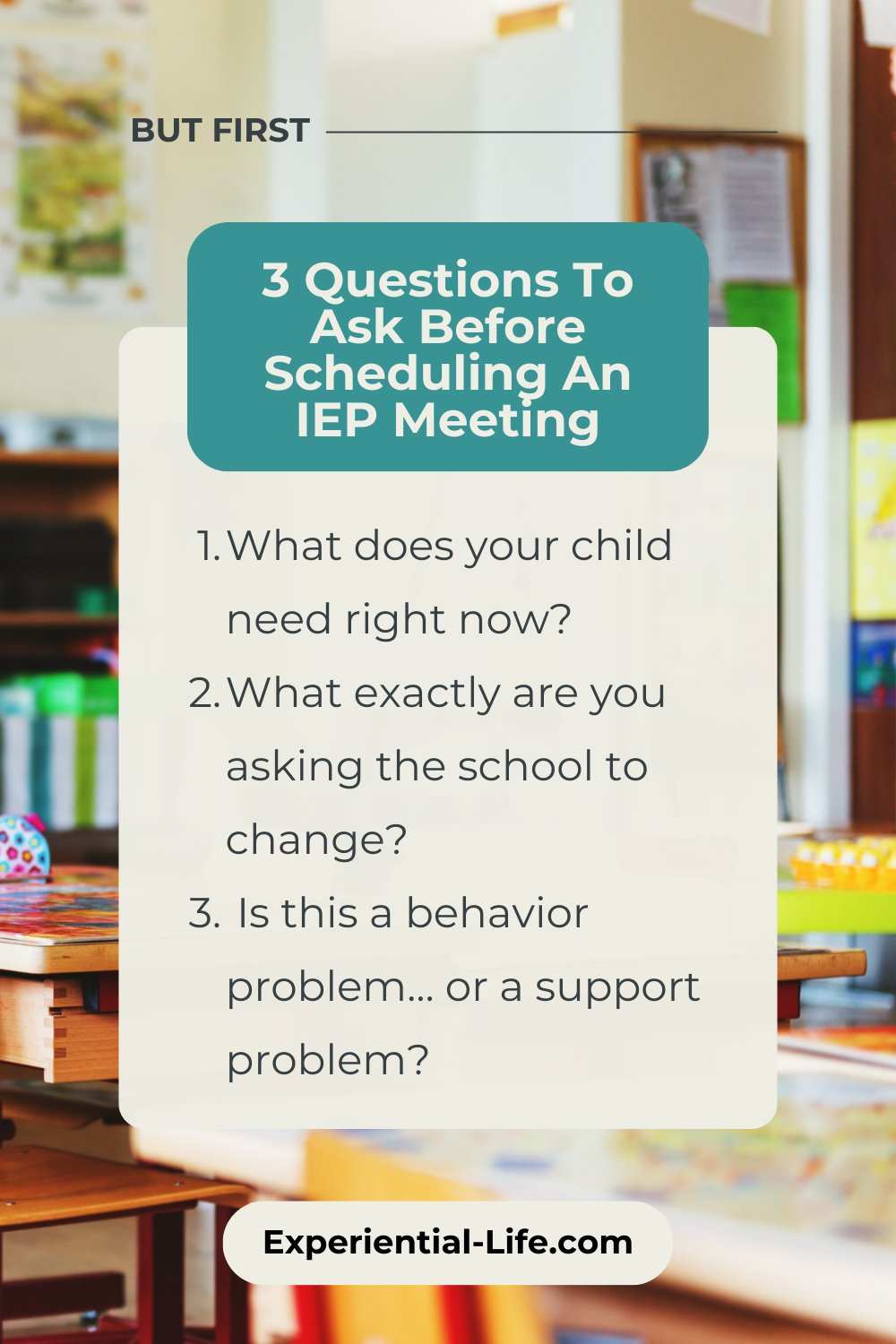
      Graphic reads: But first - 3 Questions to ask before scheduling an IEP Meeting: 1. What does your child need right now? 2. What exactly are you asking the school to change? 3. Is this a behavior problem or a support problem?

      AND there are moments when the most powerful move isn’t louder – it’s clearer.

      Sometimes you have to think two steps ahead.

      To respond strategically – not just react emotionally.

      I wanted to slow her down.

      Not because she was wrong.

      Not because the cafeteria decision didn’t deserve scrutiny.

      But because before she emailed the IEP team, I wanted her to know:

      → What does your child actually need right now?

      → What exactly are you asking the school to change?

      → Is this a behavior problem… or a support problem?

      Because those are not the same thing.

      And the answer changes everything about what you say next.

      The Question Most Families Skip

      Before you fire off the email to the principal, you have to ask:

      What does the IEP already say about transitions? About social support? About regulation?

      Because removing a child from lunch doesn’t teach regulation – and it feels a lot like punishment.

      And when a child is separated from peers as a response to behavior, that’s often a signal that the IEP needs to be revisited – not that the child needs more consequences.

      This Is What Your IEP Team Should Be Doing

      The IEP is a living document – you don’t set it and forget it. 

      It’s supposed to be updated as progress is made, or not. 

      And sometimes – it needs to be revised – right in the middle of the year.

      If you are unsure, ask yourself:

      ❓ Are the goals aligned with my child’s needs right now?

      ❓ Are the supports in place for my child or for compliance?

      ❓ Is the plan individualized, based on my unique child and their educational needs?

      When families understand how to evaluate what’s written, how it’s being implemented, and how to request changes mid-year – it stops feeling like a fight and it starts feeling the the next right move.

      They know what to ask.

      They know what to look for.

      They know what to say.

      And they stop second-guessing themselves.

      If you’ve ever asked,

      “Am I overreacting?”

      What you’re probably feeling is that something doesn’t line up – and you don’t know how to say it without making it worse.

      ​You don’t need to become an educational advocate overnight.

      You don’t need to threaten due process.

      And you don’t need to sit quietly and hope it resolves itself.

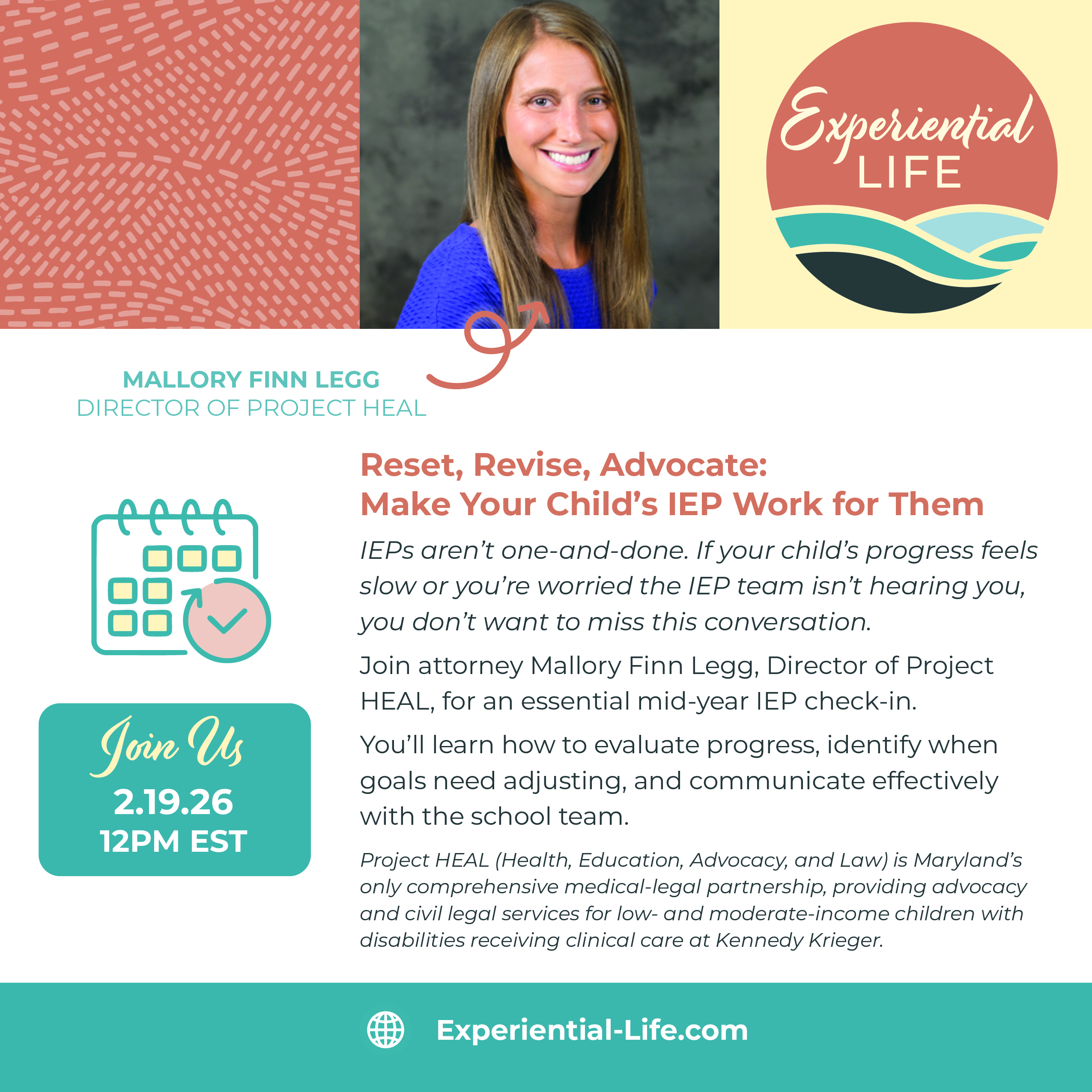
      That’s exactly why we’re hosting the Mid-Year IEP Check-In.

      We’re walking through:

      ✔️ How to request an IEP meeting mid-year

      ✔️ What to say when something feels off

      ✔️ How to evaluate whether supports are working

      ✔️ And communicate with the team – without being labeled “that parent.”

      Because you don’t have to choose between staying silent and going nuclear.

      There’s another option.

      And once you see it, you won’t unsee it.

      If you’re staring at an email draft right now…

      Or you know you will be soon – this conversation was built for you.

      Join us on February 19, 2026 at 12pm EST.


      If you’re not able to attend live, the replay lives inside the Experiential Life app.

      You can learn more here: https://experiential-life.com/experiential-life-app/

      AND, if any of this resonates, please share this with your network and subscribe to the newsletter to get instant access to future articles, weekly advocacy tips, exclusive event invites, and news you can use.
      Do you crave trustworthy information and resources to help you support your Neurodivergent child?

      Subscribe to the Experiential Life newsletter and get advocacy tips, exclusive event invites, and news you can use - delivered straight to your inbox.

        We won't send you spam. Unsubscribe at any time.
      • Deciding What Is Urgent When Raising A Neurodivergent Child

        Deciding What Is Urgent When Raising A Neurodivergent Child

        Last week, I hit a wall 🫠

        There is so much happening in our country and around the world – and it is devastating. 

        I haven’t been able to focus, everything feels urgent – and I feel powerless to help. 

        Add to the devastating news cycle, the daily decisions:

        → What to make for dinner.

        → Gotta follow up on the Medicaid waiver denial.

        Shoot – there are huge cuts to services for people with disabilities in our state.

        Crap, I need to follow up with the expert presenter for next week. 

        → Gotta remember he has an eye appointment this week. 

        Damn – I never followed up on the ENT referral for him.

        → And he wants his driver’s license… That’s a whole new fresh set of anxiety… if he fails, if he passes, other drivers on the road…

        I feel like I can’t breathe. 

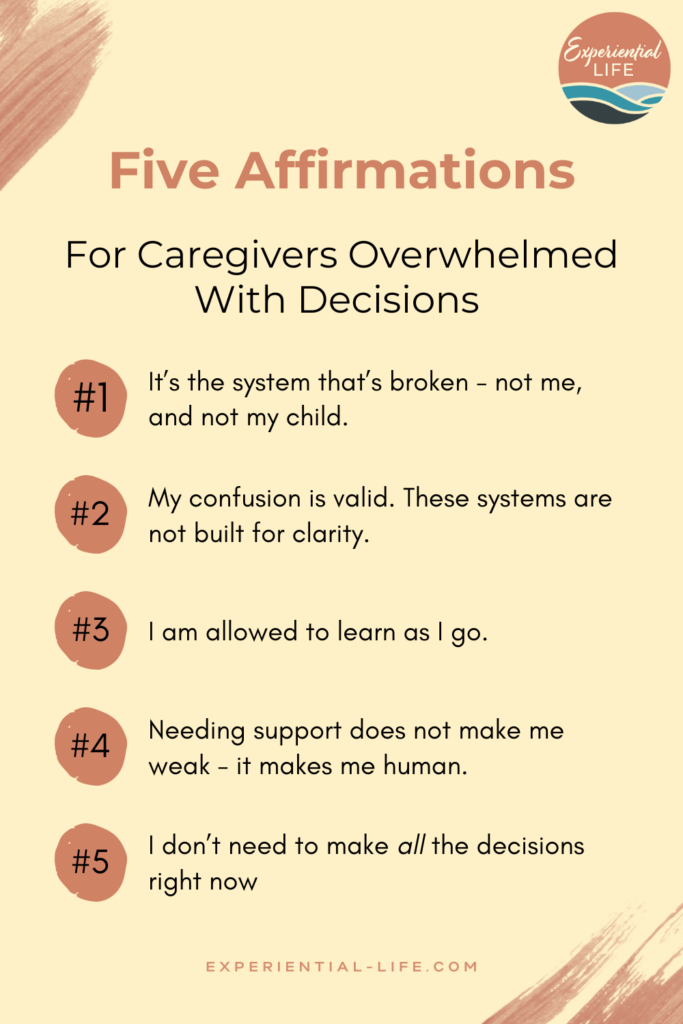
        Graphic reads: Five Affirmations for Caregivers Overwhelmed with Decisions: 1. It's the system that's broken - not me, and not my child. 2. My confusion is valid. These systems are not built for clarity. 3. I am allowed to learn as I go. 4. Needing support does not make me weak - it makes me human. 5. I don't need to make all the decisions right now. Graphic is set on a light yellow background and the Experiential Life logo sits in the top right corner.

        Everything feels urgent - and it’s just too much

        So… as one might do when faced with impossible decisions, that hit in rapid succession… I froze. 

        I couldn’t stay focused on just one thing – even the thing right in front of me – because they are all right in front of me…

        All the time. 

        Demanding my attention… along with C, asking if I could please sew up the hole he put in his Captain America plushie, for the tenth time in as many minutes.

        Why we jump into “Panic Mode” or “Freeze Mode”

        I know what’s happening – it’s a pattern I see over and over again with families raising neurodivergent kids. 

        👉 Sometimes it hits after a well-visit when you’re handed 5 referrals to different therapists and specialists. 

        👉 Sometimes it hits after an IEP meeting when the team presents goals that just don’t sit right in your stomach. 

        👉 Sometimes, it’s coming home after a really long day and having to decide what to make for dinner and then actually making it. 

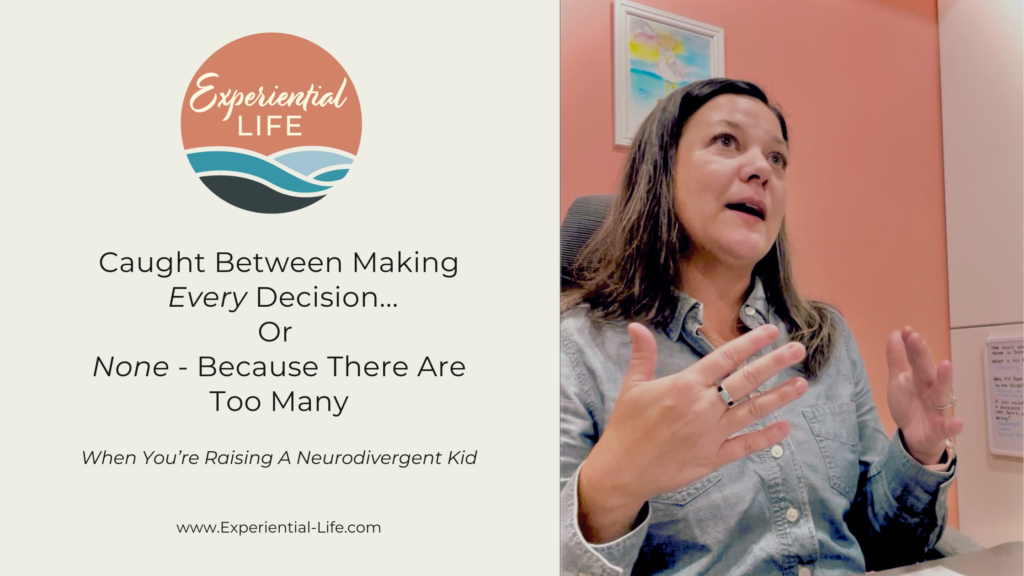
        On the left is the Experiential Life Logo, followed by: Caught between making every decision... or... none - because there are too many when you're raising a neurodivergent kid. On the right is an image of Christy (Founder and CEO of Experiential Life) wearing a blue denim button down shirt and her shortish brown hair hanging over her shoulders. She is talking with the camera catching her mid-sentence. Her hands are raised in front of her as if emphasizing a thought.

        We either panic – jump down the research rabbit hole and start making calls and decisions as if tomorrow will never come…

        Or 

        We freeze – we make no decisions because no matter how hard we try, it feels literally impossible. We don’t know where to start… and if we’re being honest with ourselves, we’re not entirely sure how.

        Both are responses to the same problem – too many decisions, with no way to tell which ones really matter right now.

        I’ve worked with over 1,000 families, and every single one of them, at some point in time, hit this inflection point. 

        I’m pretty sure my therapist would say that it is a natural response to your overwhelmed nervous system. 

        The one question that breaks the pattern

        Graphic reads: Before you make any decision... ask: What does my neurodivergent child need most right now?

        Yesterday, after feeling like not doing anything was not serving me – or this community we’re building…

        I asked myself the question I always ask families I work with:

        “What do you need most right now?”

        Prioritizing what I need to do, what I want to do, and what can wait. 

        I decided to focus on what is the most urgent thing on the list of a ton of things I need to take care of for C. 

        Highest on the list – appealing his denial for Medicaid waiver services. 

        I emailed an organization that will help me with the appeals process. 

        It didn’t solve all the problems – or help make all the decisions…But it helped me focus on one goal, one action, one potential problem solved.

        Appealing the denial of services has been my biggest stressor – especially given all the changes to Medicaid (federally and in my home state of Maryland). 

        Once I named what was causing me the most stress (denied services and supports) and why it felt so hard to follow up on (changes to Medicaid broadly) – it allowed me to focus my energy. 

        Decision fatigue or decision paralysis comes when we have too many decisions to make, all at once, and they all feel urgent – and we can’t seem to prioritize them. 

        Once I was able to identify what I needed – I was able to continue down the line of competing priorities and make a list based on level of importance (and how easy they are to just check off). 

        The appeal is the one with the closest and most urgent deadline. It had to come first. 

        And it feels hard because it is hard – I have to understand the process, what happens next, and what my choices are…

        I need someone who understands and can help me through the process – someone who works in that system and understands the rules. 

        When you’re raising a neurodivergent child, you don’t have the luxury of not making the decisions… and delaying decisions can feel like you’re failing your child. 

        So we get stuck.

        But I think what we often fail to remember is that not every decision has a hard deadline.

        Not every decision is urgent.

        And not every decision will help us with what we need most right now. 

        So if you’re feeling frozen – not lazy, not failing, just overloaded – start with one question:

        “What do I need most right now?”

        And that my friends is why Experiential Life exists…

        To help in the “in-between” moments. 

        When you feel the urge to research just one more thing before bed…

        Or when the IEP team sends the Prior Written Notice and you just need a gut check. 

        When the pediatrician hands you 3 new referrals, and you don’t know who to call first or what to say when you call. 

        Or when you read an article that says your state is cutting over 10M from disability services, but you aren’t sure what that means. 

        One place. Less overwhelm. More support.

        AND, if any of this resonates, please share this article with your network and subscribe to the newsletter to get instant access to future articles, weekly advocacy tips, exclusive event invites, and news you can use.
        Do you crave trustworthy information and resources to help you support your Neurodivergent child?

        Subscribe to the Experiential Life newsletter and get advocacy tips, exclusive event invites, and news you can use - delivered straight to your inbox.

          We won't send you spam. Unsubscribe at any time.